

Christianity proclaims that Jesus is “the way, the truth, and the life,” but do we truly grasp what this means? Often, the concept of the Trinity—Father, Son, and Holy Spirit—is misunderstood. Many don’t realize that the term “Holy Spirit” is derived from the feminine “Ruach Elohim” in Hebrew, and the Shekinah, or divine presence, is also represented as feminine in Jewish tradition. This feminine aspect within the Divine Trinity is essential to a complete understanding of the faith and is foundational to the wisdom of God.
Throughout religious history, Christianity has presented complex doctrines, sometimes creating confusion about the nature of God. For many, Jesus’ message of love, forgiveness, and redemption contrasts sharply with doctrines that seem challenging, like the concept of eternal punishment, which can appear contradictory to his message of mercy. These complexities echo the symbolic language found in the Bible, which Jesus himself often used in parables. He explained, “To you it has been given to know the secrets of the kingdom of heaven, but to them, it has not been given” (Matthew 13:11). His words suggest that many teachings are mysteries meant to be uncovered by those open to divine wisdom.
The Mystery of the Divine Feminine
In the opening of the Gospel of John, we read, “In the beginning was the Word, and the Word was with God, and the Word was God… In him was life, and that life was the light of all mankind” (John 1:1-4). This passage presents the Logos, or divine Word, as a powerful force of creation and truth. Alongside this Logos, however, is Sophia, or divine Wisdom, an essential part of God’s nature often associated with the Holy Spirit. The Book of Proverbs personifies Wisdom as a woman, saying, “Wisdom has built her house; she has set up its seven pillars” (Proverbs 9:1), emphasizing the role of the feminine in the spiritual foundation of the universe.
Jesus promised that the Holy Spirit would come to bring enlightenment and guidance: “But the Comforter, the Holy Spirit, whom the Father will send in my name, he shall teach you all things and remind you of everything I have told you” (John 14:26). In early Christian thought, the Holy Spirit was often understood as a feminine presence, embodying divine wisdom and nurturing insight.
The Logos and Sophia: The Divine Union of Wisdom and Truth
The Logos (the Word) and Sophia (Wisdom) are deeply connected in understanding God’s creative and redemptive work. Just as the Word was with God in the beginning, Sophia was also present, as Proverbs describes: “The Lord possessed me at the beginning of his work, the first of his acts of old” (Proverbs 8:22). This union of Word and Wisdom, masculine and feminine, is reflected in the divine love that Jesus demonstrated throughout his ministry.
In the Gnostic Gospel of Thomas, Jesus speaks of unifying the masculine and feminine within oneself as a pathway to spiritual wholeness: “When you make the two into one, and when you make the inner like the outer and the outer like the inner, and the upper like the lower… then you will enter the kingdom” (Saying 22). This teaching highlights the balance and integration of divine attributes necessary for spiritual enlightenment and unity with God.
The Role of Parables in Revealing Truth
Jesus often taught through parables, simple stories filled with deep spiritual truths. He said, “I speak to them in parables because seeing they do not see, and hearing they do not hear, nor do they understand” (Matthew 13:13). Parables were designed for those seeking wisdom, for whom divine understanding would be granted. One such parable, the Parable of the Mustard Seed, speaks to the potential of divine growth within each of us: “The kingdom of heaven is like a grain of mustard seed…when it is grown, it is the greatest among herbs” (Matthew 13:31-32). This growth from a small seed to a mighty tree illustrates the journey of our faith and divine potential.
The Divine Plan: Uniting Humanity with the Divine Family
In Romans, Paul speaks of humanity’s divine destiny, saying, “For those whom he foreknew he also predestined to be conformed to the image of his Son” (Romans 8:29). Jesus, as the firstborn among many, calls each of us to realize our own divine potential, joining him as members of God’s family. This journey of transformation is a process of enlightenment, as Paul describes in 2 Corinthians 3:18: “And we all, with unveiled face, beholding the glory of the Lord, are being transformed into the same image from one degree of glory to another.” This divine family—Father, Mother (Wisdom), and Son (Logos)—reflects our own journey to spiritual wholeness, revealing God’s interconnected nature.
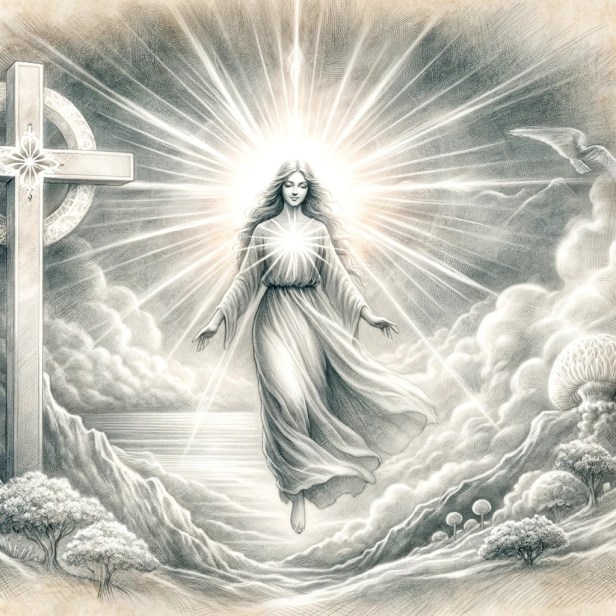
Mary and the Divine Feminine: The Role of the God-Bearer
Mary, the mother of Jesus, is celebrated in Christian theology for her unique role as Theotokos, or God-bearer. Her willingness to accept God’s call to bear Christ, the divine Word, reflects the feminine principle of receptivity, nurturing, and wisdom. When the angel greets her with, “Hail, thou that art highly favored, the Lord is with thee” (Luke 1:28), it acknowledges her distinct place in God’s plan, underscoring the importance of the feminine in the incarnation of divine love.
In some Christian traditions, Mary is honored as the Queen of Heaven, reflecting the reverence for the feminine’s role within the divine hierarchy. Her life exemplifies the union of humanity and the divine, showing how the feminine presence is integral to God’s work of salvation.
The Science of Spiritual Growth
The Bible is not just a historical text but a spiritual guidebook, one that reveals universal principles of life and growth. As Paul writes in Romans, “Be not conformed to this world, but be transformed by the renewing of your mind” (Romans 12:2). This renewal, led by the Holy Spirit, allows us to align with God’s will. Christianity, when understood beyond literal interpretations, becomes a journey of personal transformation that leads us into a fuller relationship with God.
Through this journey, the Holy Spirit, or Wisdom, illuminates the hidden meanings within scripture, deepening our understanding and helping us grow in divine love and knowledge. This process, led by the Spirit, is how we come to embody the love and wisdom that Jesus taught.
Conclusion: Embracing the Divine Wisdom and the Feminine in Our Spiritual Journey
Christianity, when explored with an open heart and mind, reveals profound truths about God’s nature and our purpose within creation. Jesus calls us to follow him on a journey that integrates the masculine and feminine within ourselves, reflecting the divine family of Father, Mother (Wisdom), and Son (Logos). This journey is guided by the Holy Spirit, who leads us into all truth, teaching us the mysteries of faith and divine love.
The feminine aspect of the divine, often overlooked, is essential to understanding God’s full nature. Proverbs reminds us of Wisdom’s foundational role in creation: “The Lord by wisdom founded the earth; by understanding, he established the heavens” (Proverbs 3:19). Recognizing the divine feminine within the Holy Spirit brings a new dimension to our relationship with God, enhancing our appreciation of the depth of His love and the interconnectedness of all creation.
As Jesus taught, “I am the way, the truth, and the life. No one comes to the Father except through me” (John 14:6). This statement is not merely about belief in Jesus but an invitation to explore a deeper understanding of life, guided by divine wisdom. By embracing the feminine aspects of God and seeking the enlightenment offered by the Holy Spirit, we uncover the profound mysteries of the faith and our place within the divine order.
In this approach, Christianity transcends a mere set of doctrines; it becomes a spiritual journey that harmonizes the masculine and feminine within us and draws us closer to the divine family. As children of God, we are called to live in unity with the Father, the Son, and the Holy Spirit, embodying divine love and wisdom as we fulfill our spiritual potential in God’s ongoing creation.
 Life Tronic Cell