
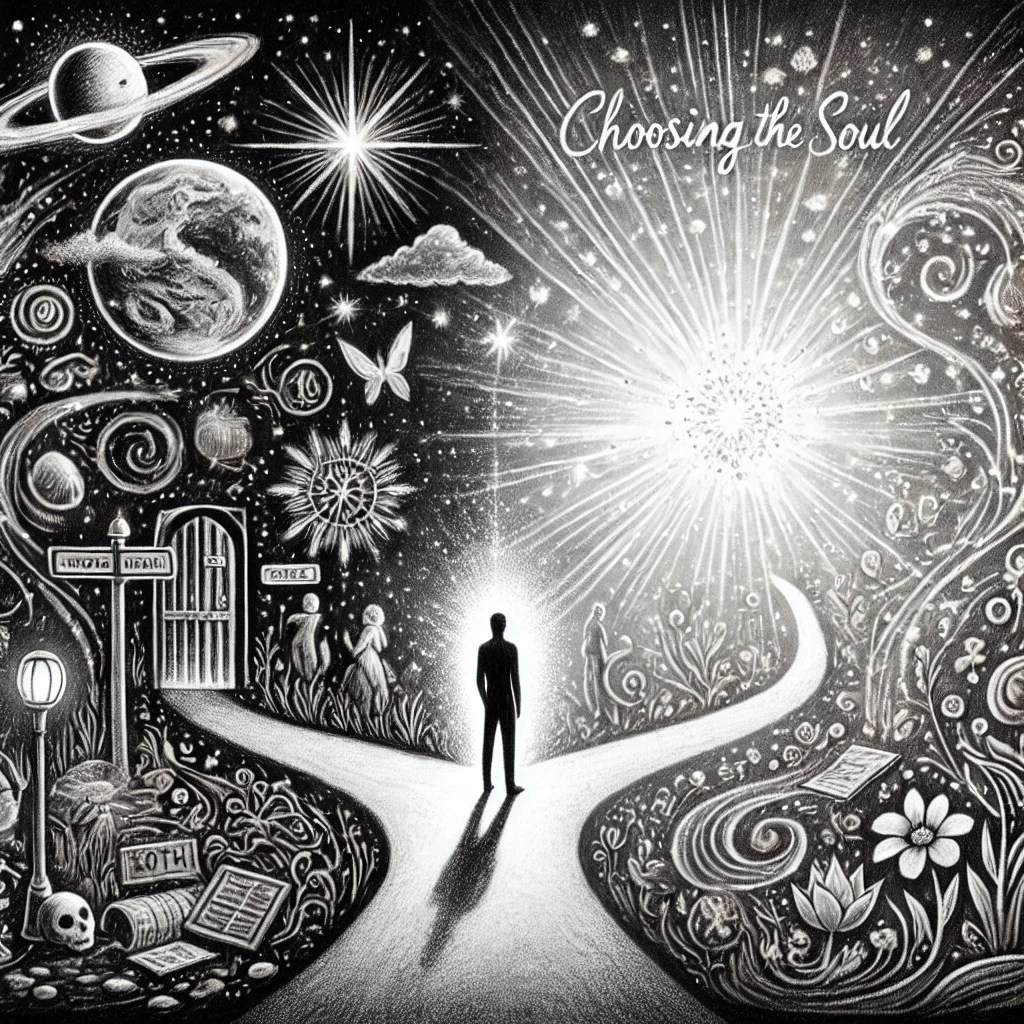
“You can choose the body or the soul, and we will show you who you truly are.” These were the words spoken to me by two angelic beings who appeared in my room, their forms like radiant golden discs, their voices reverberating outward in waves, like ripples on a pond. They spoke as if they embodied the two polarities of God—male and female—giving me a choice that felt profound, almost like a crossroads. They showed me that most people choose the body, identifying with the physical self in a world that idolizes the body and its image. Yet they reminded me that if I chose the soul, I would discover who I truly am in my entirety, beyond the body.
It is a choice that presents itself every day, but it’s not an easy one. Our society, through mass media, entertainment, and culture, constantly reinforces attachment to the body. The body is idolized, sexualized, and adorned to align with societal ideals, and many believe that grounding oneself in the body is essential to experiencing life. We seek to unify the body with the soul, thinking we can merge our emotions, desires, and self-image into one harmonious identity. Yet, this attachment to the body often leads to endless confusion and suffering, pulling us further from the essence of who we are.
From the clothes we wear to the makeup and tattoos we apply, society encourages us to shape the body into a reflection of our self-perception. We look in the mirror, thinking, “This is who I am.” But this attachment to the body is only a mask, a superficial expression that covers our deeper, divine identity.
In our media and entertainment, the body and its powers are idolized as the source of all strength and identity. Superheroes and characters with “superior” genetics are granted extraordinary abilities, reinforcing the idea that the body is paramount. Even the concept of spiritual ascension is often portrayed as something attainable through intellect, secret knowledge, or mystical practices. Yet, all of these pursuits—whether through knowledge or sacred geometry—can never truly reveal the soul’s reality. They remain distractions from the true path: the removal of everything we are not, creating space within us so that God may enter.
To discover who we truly are, we must continually choose the soul over the body, seeing the external world for what it is—an endless play of drama and attachment that draws us away from the divine. This realization comes when we no longer allow ourselves to be influenced by the endless stream of news, political debates, and entertainment that fill our minds with images of conflict and desire.
When we engage with media, we tap into a mass consciousness infused with the creators’ ideas, beliefs, and agendas. Movies and shows are laced with narratives, values, and temptations that pull us deeper into the material world, away from the soul. In these stories, darkness is often glamorized; we spend more time learning about evil than embracing the light. The world glorifies the dark and sensational, yet shies away from the purity and light of God. A movie about God’s love and light would be less popular than one filled with violence and darkness, reflecting humanity’s fascination with the lower appetites.
To choose the soul is to choose a life rooted in divine truth rather than worldly illusions. It means awakening each day and affirming, “I choose the soul.” This conscious choice helps us rise above the noise of the world and connect with our true essence. The path is not easy, but it is clear: remove all that you are not, and you will begin to see who you truly are. Through this process, we align ourselves with God and realize the true reason for our existence—not to be of the world, but to transcend it, living as eternal beings of light.
 Life Tronic Cell