
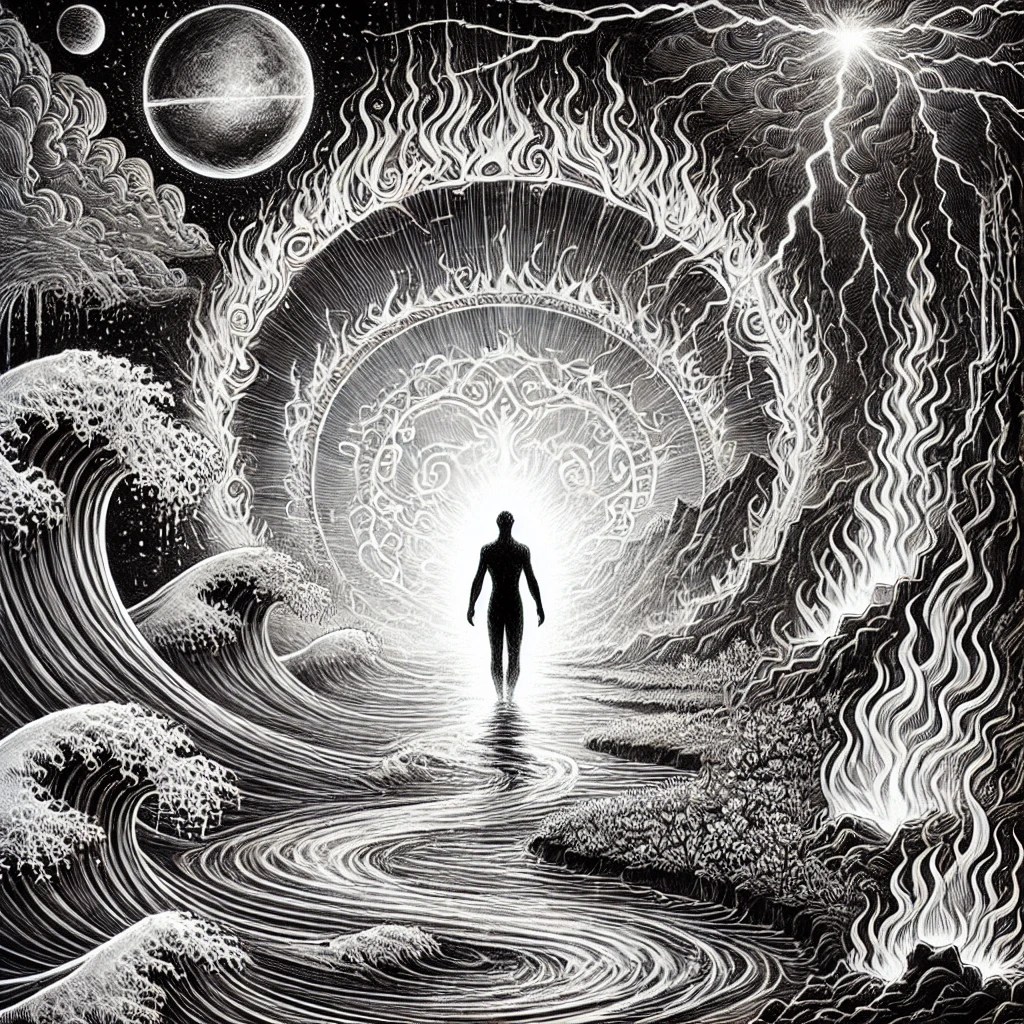
Throughout history, spiritual journeys have often been marked by transformative rites of passage—baptisms by water, fire, and spirit. My own journey has led me through each of these baptisms in a profoundly real way, experiencing the cleansing and purifying force of the Holy Spirit within my very being. These baptisms are not mere physical acts of immersion in water, fire, or electricity, but rather deep, inner encounters with the elements, manifesting in ways that touch the soul and cleanse the ego.
An ancient story tells of a teacher over two thousand years ago who, upon hearing that the world was ending, calmly resumed his studies. He saw beyond the material world, recognizing his own invincibility as an eternal being. His reaction may seem curious to those who associate closely with the physical body; to them, such news would bring terror. But when one understands the deeper, eternal nature of the self, the end of physical existence does not halt the pursuit of inner knowledge and growth.
This understanding of self as eternal shifts one’s approach to life’s rites of passage, including baptism. Traditionally, baptism by water symbolizes the first step in spiritual cleansing. In my own meditation, I vividly experienced water rising around my feet, flowing upwards to cover my body—a baptism of water that transcended the physical. It was a preparation, a prelude to the next stages of spiritual initiation.
Following this, I encountered the baptism of fire. Fire represents purification and the burning away of ego and impurities. This baptism was more intense than water, demanding a surrender to the purifying heat that burns through the false self, shedding layers of ego and worldly attachment. Fire baptizes us into an understanding that we are not merely physical beings but spiritual entities undergoing transformation.
Next came the baptism by electricity, the spark of life and the force that awakens divine knowledge within. This electrifying experience heightens our awareness, illuminating the higher frequencies of the soul and intensifying the connection to the Holy Spirit. This baptism infuses the soul with divine energy, sharpening awareness and aligning us with our true, eternal essence.
Each of these baptisms—water, fire, and electricity—has its own transformative effect. Water soothes and purifies, fire burns away the ego, and electricity awakens the divine within. But beyond these three is the lesser-known element, ether, which symbolizes the spiritual void from which all creation emerges. Ether, once recognized in ancient science as an element, was later removed from the periodic table, subtly diminishing its presence in our collective consciousness. Its absence mirrors our disconnection from the “zero-point energy” that permeates the universe.
In a vision, I received a message: balance your elements. This balance is a critical step in transcending the ego and aligning with the divine. By embracing water, fire, electricity, and ether, we dissolve the ego bit by bit. Each element contributes to the spiritual progression—the water submerges the ego, the fire burns it, and the electricity electrifies it—until there is nothing left but the pure soul, free from attachment.
Through this process, one begins to transcend the identification with the body. We realize the ego is an illusion, existing only as long as we give it power. As we let go of attachment to the body and worldly distractions, we grow lighter in spirit, closer to the essence of our divine self. We come to embody the ideal: “I am not the body.”
Over time, as we immerse ourselves in these baptisms and release the trappings of the ego, we align more closely with the Holy Spirit. We become one with the Holy Spirit as a motherly flame, the electric energy of the Father, and the living water of the Son. This is the triune journey—the journey of unity with the Divine—and through it, we become one with the eternal essence, embracing the truth of our existence as beings of light.
Ultimately, when we are free from all attachment, the yoke of our soul becomes light.
 Life Tronic Cell