
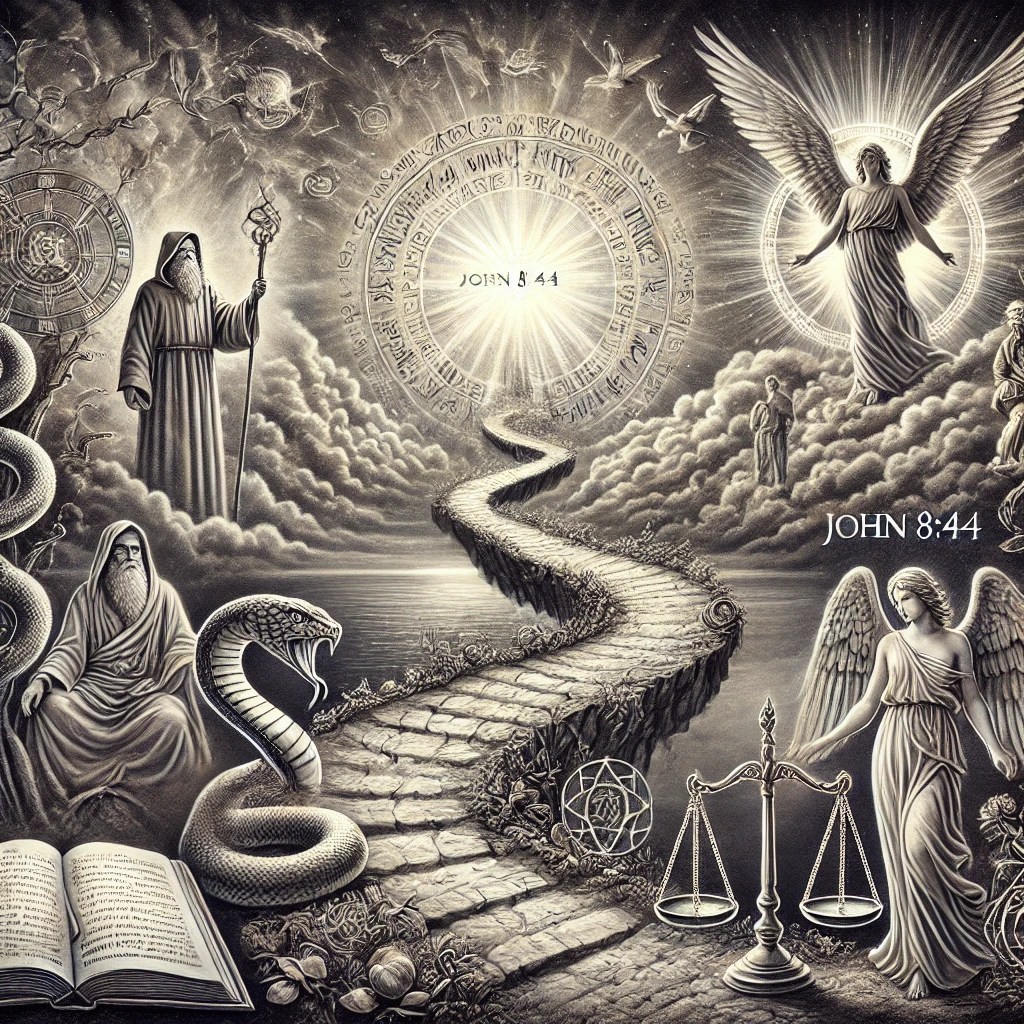
When I first encountered John 8:44, its boldness struck me:
John 8:44 (NIV): “You belong to your father, the devil, and you want to carry out your father’s desires. He was a murderer from the beginning, not holding to the truth, for there is no truth in him. When he lies, he speaks his native language, for he is a liar and the father of lies.”
This verse challenged me to dig deeply into the concepts of truth, deception, and divine justice. It set me on a journey through traditional Christian teachings and into the profound, often enigmatic world of Gnostic thought.
Discovering the Gnostic Perspective
As I delved into Gnostic texts, I began to see the spiritual battle described in the Bible through a different lens. Gnosticism painted the material world as an imperfect realm created by a being they called the Demiurge—a powerful yet flawed entity who believed itself to be the ultimate God. This perspective radically redefined how I understood the divine narratives I had grown up with.
One text, The Apocryphon of John, illuminated the nature of this being with the declaration:
“I am a jealous God, and there is no God but me!”
This statement challenged my understanding of justice in the Old Testament. The Gnostics saw such harsh judgments and severe punishments not as expressions of divine love but as the actions of a lesser being enforcing control over a flawed creation. It was both unsettling and deeply thought-provoking.
See full video: https://www.youtube.com/watch?v=GWHLuZgixHI&list=LL&index=1
Jesus as the Bearer of Divine Knowledge
In Gnostic thought, Jesus is more than a savior in the traditional sense. He is a revealer of gnosis—a transformative knowledge that awakens the soul to its divine origin. This idea resonated with me on a profound level, as if Jesus were inviting me to look beyond the illusions of the material world and discover the truth within myself.
One passage from The Gospel of Thomas particularly moved me:
“Jesus said, ‘I am the light that is over all things. I am all: from me all came forth, and to me all attained. Split a piece of wood, and I am there. Lift up the stone, and you will find me there.’”
This challenged me to rethink where and how I encounter God. It was no longer about external rituals or structures but an inward awakening to the divine presence within all creation—and within myself.
The Nature of the Demiurge
Gnostic theology reinterprets the Genesis creation narrative, portraying the Creator as the Demiurge—a being powerful but ignorant, mistakenly believing itself to be God. The material world, created by this being, is seen as a flawed reflection of divine reality, filled with suffering, deception, and impermanence.
In The Apocryphon of John, the Demiurge’s arrogance is captured in its declaration:
“I am a jealous God, and there is no God but me!”
The Gnostics saw this blindness as the root of the material world’s imperfections. This interpretation didn’t reject the Hebrew Bible outright but reframed its narratives within a broader spiritual context. The severe punishments and rigid laws attributed to Yahweh were seen not as ultimate divine justice but as actions of a limited being enforcing its control.
Truth and Falsehood: A Spiritual Battle
Reflecting on John 8:44, I began to see its connection to the Gnostic framework. The “father of lies” represents more than an external adversary; it symbolizes ignorance and deception—forces that keep humanity trapped in the illusions of the material world.
Gnostic texts expand this idea to include the Demiurge and its agents, who perpetuate false realities. For me, this deepened my understanding of the spiritual battle described in the Bible, emphasizing not just a fight against sin but a struggle to overcome the ignorance that blinds us to divine truth.
Reconciling Justice in the Old Testament
I’ve long wrestled with the harsher depictions of Yahweh in the Old Testament—stories of floods, genocides, and strict laws that seemed to conflict with the loving God revealed through Christ. The Gnostic perspective offered a new framework for these narratives.
Take the flood in Genesis: Yahweh’s decision to cleanse the earth of corruption could be seen as an act of justice. Yet, through a Gnostic lens, it also appears as the action of a creator trying to control a flawed creation that has slipped out of alignment. This doesn’t reject God’s sovereignty but invites deeper reflection on the complexities of divine justice.
What I’ve Learned on This Journey
This journey has taught me that the battle between truth and deception is not only external but profoundly internal. Gnosticism, with its focus on knowledge and enlightenment, has offered me several key insights:
- Discernment Is Essential: I’ve learned to question, seek, and discern what aligns with divine truth instead of simply following blindly.
- The Divine Is Within: As Jesus said in The Gospel of Thomas, the kingdom is both inside and outside of me. This realization challenges me to grow spiritually through inward reflection.
- Knowledge Brings Freedom: Liberation from sin and ignorance comes through understanding my true nature and relationship with God.
Moving Forward in Faith
As I continue this journey, I find myself blending traditional Christian teachings with insights from Gnostic thought. Jesus remains my savior, but he is also my guide to a deeper and more transformative relationship with the divine.
John 8:44 remains central to my reflections. Whether viewed through the lens of the Bible or Gnosticism, it calls me to align with truth and reject the deceptions that hinder my understanding of God. This journey is far from over, but each step brings me closer to the profound mystery of divine truth—one that invites me to seek, question, and embrace the light that sets us free.
 Life Tronic Cell