
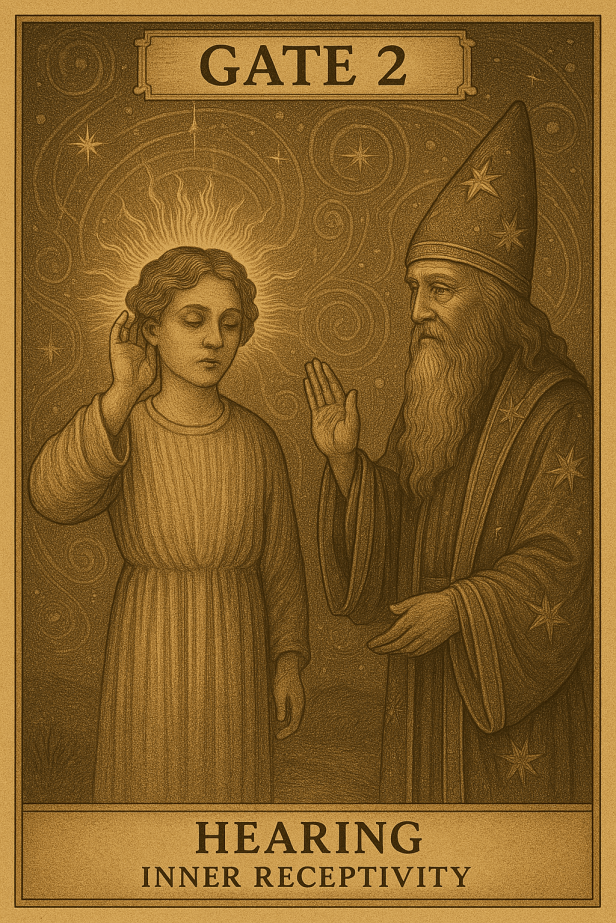
Theme: The Inner Ear of the Soul – Hearing the Living Word
I. INTRODUCTION: THE GATE OF LISTENING
The second gate in the divine journey through the New Jerusalem is marked with the name Simeon, the second son of Jacob and Leah. His name, שִׁמְעוֹן (Shim’on) in Hebrew, literally means “he has heard” or “hearing.” This is no small attribute; it is a cosmic faculty, a spiritual organ within the soul. Just as the first gate (Reuben) unveils identity—“Behold, a son”—this second gate unveils relationship—the hearing heart that responds to the voice of God.
“And when the Lord saw that Leah was hated, He opened her womb: but Rachel was barren. And Leah conceived, and bare a son, and she called his name Simeon: ‘Because the Lord hath heard that I was hated, He hath therefore given me this son also.’”
— Genesis 29:33
In this sacred context, to hear is not a passive biological function, but an act of communion. The soul enters this gate when it begins to discern not just words spoken to the ear, but the Logos whispered within. The threshold of Simeon is for those who are no longer content with doctrines or dogmas—but desire to hear the Living Voice of the Spirit.
II. QUALITIES NEEDED: SPIRITUAL HEARING (SHEMA)
The Hebrew concept of hearing is far richer than our modern understanding. The foundational Jewish prayer, the Shema, begins:
“Hear, O Israel: The LORD our God, the LORD is One.”
— Deuteronomy 6:4
This “hearing” (שְׁמַע) does not merely mean sound entering the ears. It means:
- To perceive deeply
- To internalize and reflect
- To obey or live in accordance
The Gate of Simeon demands this kind of hearing—a hearing of the soul, a responsiveness that aligns life to the whispered direction of the Divine.
“Incline your ear, and come unto me: hear, and your soul shall live.”
— Isaiah 55:3
Jesus echoes this again and again:
“He that hath ears to hear, let him hear.”
— Matthew 11:15
These are not physical ears. They are the inner faculties of perception and surrender. To pass through this gate, the soul must undergo a conversion of the ear—from outer clamor to inward stillness.
III. INNER REQUIREMENT: ATTUNEMENT TO THE INNER VOICE
The journey through this gate demands that one attune—like a musician tuning an instrument—not to external voices, but to the vibration of the Spirit. The world is full of noise: opinions, fears, doctrines, laws, traditions, systems. But the Voice of God speaks beneath and through the silence.
“And behold, the Lord passed by… and after the fire a still small voice.”
— 1 Kings 19:11–12
To “hear” in the way of Simeon is to be like young Samuel:
“Speak, Lord, for thy servant heareth.”
— 1 Samuel 3:10
And to be like Jesus:
“I do nothing of myself; but as my Father hath taught me, I speak these things.”
— John 8:28
He did not act from logic or law, but from union with the voice of the Father. So too must every initiate of this gate: live from listening—from real-time communion.
IV. WHAT TO BRING: OBEDIENCE TO INNER GUIDANCE, NOT OUTER LAW
This gate does not ask for ritual compliance or perfect moral record. It asks for availability. A heart surrendered enough to obey when the Word comes—not just in scripture, but in the inner promptings of the Spirit.
“For as many as are led by the Spirit of God, they are the sons of God.”
— Romans 8:14
There is a kind of obedience greater than the law: it is love-guided responsiveness. Not rule-following, but relational fidelity. This is the obedience that Abraham showed—not because of a written command, but because he heard and followed the voice of God (Genesis 22).
Jesus said:
“My sheep hear my voice, and I know them, and they follow me.”
— John 10:27
This is the sacred movement of the soul that listens deeply, not to religious noise, but to the inner Shepherd.
V. MELCHIZEDEKIAN INSIGHT: THE WORD IS ALIVE WITHIN
The priesthood of Melchizedek is not bound by written tradition, but by living communion. The Melchizedekian initiate lives from the Logos—the living Word—which is not merely historical, but present.
“For the word of God is alive and active, sharper than any double-edged sword…”
— Hebrews 4:12
This Word is not dead ink. It is not trapped in history. It is the ongoing, inward revelation of the Spirit.
“You have no need that any man teach you: but as the same anointing teaches you of all things, and is truth…”
— 1 John 2:27
To walk in the Melchizedekian way is to have the Word engraved not on stone, but upon the heart:
“I will put my law in their inward parts, and write it in their hearts…”
— Jeremiah 31:33
Thus, Simeon’s gate is the gate of inward hearing, where the soul no longer lives by the echo of others’ experiences, but by the direct whisper of God within.
VI. SPIRITUAL PARALLELS IN SCRIPTURE
- Simeon in the New Testament:
The aged Simeon in Luke 2:25–32 awaited the “consolation of Israel,” and was led by the Spirit to behold the infant Christ. “It was revealed unto him by the Holy Ghost, that he should not see death, before he had seen the Lord’s Christ… and he came by the Spirit into the temple.”
— Luke 2:26–27 This Simeon heard and followed Spirit-to-spirit communication—not tradition. It is a pattern for every soul who wishes to behold Christ. - Mount of Transfiguration:
At the mountain, the Father says: “This is my beloved Son… hear ye Him.”
— Matthew 17:5 Not just see—but hear. The deeper recognition of the Son comes not through the eye, but the ear of the soul.
VII. CONTEMPLATIVE REFLECTIONS
- Whose voice am I really following?
- The media? Teachers? Family? Or the still small voice within?
- What have I drowned out by noise and busyness?
- The voice of the soul is subtle, and is most audible in silence.
- What would radical spiritual listening look like in my life?
- Am I willing to follow without full explanation? To obey the Light within?
VIII. PRAYER FOR PASSING THROUGH THE SECOND GATE
Spirit of Truth,
I approach the Gate of Simeon—let my ears be opened.
May I hear the voice beneath all voices—the soundless Word, the inner Christ.
Let me no longer live by echoes and traditions.
Let me walk in the melody of the Spirit.
Give me a heart that responds with love, a mind that follows in trust.
Speak, Lord… for I am listening.
Amen.
IX. CONCLUSION: THE GATE OF RESPONSE
If Reuben’s gate is identity, Simeon’s is response. Hearing is how the son begins to walk in relationship. It is the activation of the covenantal life, where the soul not only knows itself as divine, but begins to live by divine impulse.
This gate is about attunement. It is about shifting from external religion to internal resonance—from memorizing verses to becoming a verse, living epistles written by the Spirit (2 Corinthians 3:3).
“Today, if ye will hear His voice, harden not your hearts.”
— Hebrews 3:15
Let this be the day the inner ear opens.
Let this be the moment the voice of God returns—not from the sky, but from within.
This is Gate 2: Simeon—the awakening of the Hearing Soul.
 Life Tronic Cell