
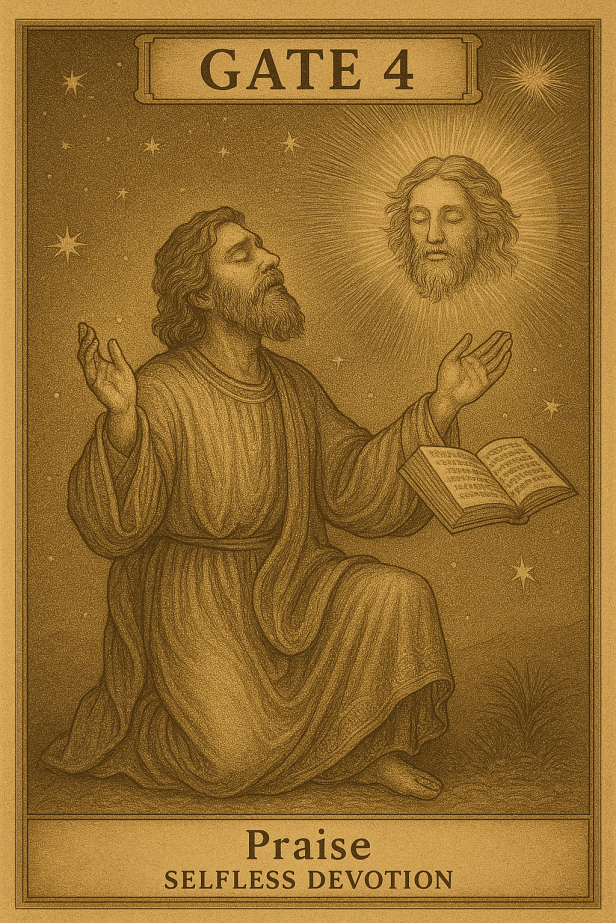
Theme: Entering the Kingdom through Gratitude and Surrendered Praise
I. INTRODUCTION: THE GATE OF PRAISE AND RADIANT GRATITUDE
Gate Four, named Judah, is the portal of pure worship—the threshold at which the soul no longer seeks only identity (Reuben), intuitive hearing (Simeon), or union (Levi), but now stands in full adoration of the Light. This gate initiates the soul into divine rejoicing, into the state of perpetual gratitude and surrendered praise, regardless of circumstance.
The name Judah (יְהוּדָה – Yehudah) comes from the root יָדָה (yadah), which means “to praise,” “to give thanks,” or “to confess.” Judah was the fourth son of Jacob and Leah. His name was born out of gratitude:
“And she conceived again and bore a son, and said, ‘Now will I praise the LORD.’ Therefore she called his name Judah; and left bearing.”
— Genesis 29:35
This is the first instance of praise in the Bible, and it issues from unconditional gratitude, not from fulfilled desire. Leah did not receive Jacob’s love—but she received the grace of life and honored God for it.
Thus, the Gate of Judah teaches us that true praise is not transactional—it is transcendent.
II. QUALITY NEEDED: PURE WORSHIP
The requirement to pass this gate is not mastery, knowledge, or even moral perfection—it is purity of heart in worship. It is a soul that adores the Light not because of reward, but because it recognizes the holiness of the Source.
Jesus defines worship not by form, but by essence:
“But the hour cometh, and now is, when the true worshipers shall worship the Father in spirit and in truth: for the Father seeketh such to worship Him.”
— John 4:23
This worship is:
- Spiritual – not dependent on external rituals or places
- Truthful – emerging from the authentic state of the soul
- Continuous – not occasional, but a way of being
Such worship is not emotional performance. It is the recognition of God’s worthiness—regardless of one’s condition. It is inner stillness lit with the fire of love and reverence.
“Let everything that hath breath praise the Lord. Praise ye the Lord.”
— Psalm 150:6
To breathe is to qualify. The soul enters this gate not by merit, but by a heart tuned to exaltation.
III. INNER REQUIREMENT: LIVE IN GRATITUDE, GLORIFY THE LIGHT IN ALL THINGS
This gate cannot be opened with complaint or bitterness. It is only opened by the attitude of thanksgiving—by the consciousness that glorifies Light in all things, not just pleasant ones.
“In every thing give thanks: for this is the will of God in Christ Jesus concerning you.”
— 1 Thessalonians 5:18
To glorify the Light “in all things” means:
- When you’re in lack, give thanks for the inner abundance.
- When you’re in darkness, praise the coming dawn.
- When you’re in suffering, bless the hidden grace.
This is not denial—it is spiritual transmutation. The soul chooses to praise not because all is perfect, but because God is present in all.
“Though the fig tree shall not blossom… yet I will rejoice in the Lord, I will joy in the God of my salvation.”
— Habakkuk 3:17–18
This is the secret of Judah’s praise: it is not reactive, but creative. It is not based on outer blessings—it births them.
IV. WHAT TO BRING: A SONG OF THE SOUL, A SURRENDERED EGO
To pass through the Gate of Judah, one must bring a soul-song—not necessarily music or poetry, but a frequency of authentic joy and praise rising from the depths of being.
This inner music is what David refers to when he says:
“Sing unto the Lord a new song; sing unto the Lord, all the earth.”
— Psalm 96:1
It is not a borrowed song, or a repeated hymn—it is a spontaneous praise that rises when the soul is fully aligned with the Spirit.
But this song cannot be sung with a loud ego. It requires surrender. True praise is the death of self-centeredness.
“Let the high praises of God be in their mouth, and a two-edged sword in their hand.”
— Psalm 149:6
This sword cuts away pride and entitlement. It purifies the soul until it becomes a vessel of praise.
David understood this well:
“Create in me a clean heart, O God… Restore unto me the joy of Thy salvation…”
— Psalm 51:10–12
The ego cannot praise. Only the humble heart can magnify God.
“My soul doth magnify the Lord, and my spirit hath rejoiced in God my Savior.”
— Luke 1:46–47 (Mary)
V. MELCHIZEDEKIAN INSIGHT: CHRIST CONSCIOUSNESS ARISES IN HEARTS THAT PRAISE, NOT COMPLAIN
This is the high mystery of this gate: praise is not just a spiritual act—it is a vibrational state in which the Christ is born. When the soul is in complaint, it is closed. When it praises, it opens to incarnation.
“But thou art holy, O thou that inhabitest the praises of Israel.”
— Psalm 22:3
God does not merely enjoy praise—He inhabits it. He manifests through it. In the heart that praises, Christ takes form.
Complaint is rooted in ego, fear, and illusion. But praise springs from truth, trust, and the abiding presence of divine light.
When Paul and Silas were imprisoned and beaten, they did not murmur. They praised.
“And at midnight Paul and Silas prayed, and sang praises unto God… and suddenly there was a great earthquake… and everyone’s bands were loosed.”
— Acts 16:25–26
Praise breaks chains—not just physically, but spiritually. It is the posture of freedom, the frequency that aligns the soul with the Throne of Light.
The Melchizedekian priesthood is a priesthood of eternal praise. It does not wait for outer conditions to align—it manifests divine presence through praise itself.
VI. THE LION OF JUDAH: KINGLY POWER THROUGH PRAISE
Judah was not only the tribe of praise; it became the tribe of kings. David was of Judah. Jesus, the Christ, is called:
“The Lion of the tribe of Judah, the Root of David…”
— Revelation 5:5
There is power in praise. Praise is not weakness—it is royal authority. To pass through this gate is to become a priest-king, one who ministers unto God and reigns in Christ.
“Out of the mouth of babes and sucklings hast thou ordained strength because of thine enemies…”
— Psalm 8:2
Praise becomes spiritual warfare, royal declaration, and divine enthronement. The soul that praises rules—not with domination, but with radiance.
VII. CONTEMPLATIVE REFLECTIONS
- Do I praise God only when things go well?
- Or is my praise rooted in who He is, not what I receive?
- Is there complaint in my heart that blocks worship?
- Complaint is the song of bondage. Praise is the song of freedom.
- Have I surrendered ego enough to sing a new song?
- Can I let go of performance and offer my soul in joy?
VIII. PRAYER FOR PASSING THROUGH THE FOURTH GATE
Lord of Light,
I come to the Gate of Judah with a bowed heart and lifted hands.
Let me praise You—not for gain, but because You are worthy.
Burn away the layers of pride, fear, and control.
Let my soul rise in a new song.
Let gratitude overflow even in the dark.
Let Christ be born in the atmosphere of praise.
I enthrone You in my worship.
I rejoice in You alone.
Amen.
IX. CONCLUSION: THE GATE OF THE SINGING HEART
The Gate of Judah is not a gate you pass with strength—it is a gate you pass with praise. And this praise is not performance—it is the fragrance of a surrendered life.
It is the gate where kings are made, where the Lion of Christ awakens within, and where chains fall without force.
It is the gate that prepares the soul to reign—not in hierarchy, but in worship and light.
“Enter into His gates with thanksgiving, and into His courts with praise: be thankful unto Him, and bless His name.”
— Psalm 100:4
This is Gate 4: Judah – Praise.
Let your soul become a sanctuary of song.
Let your praise enthrone the Christ within.
 Life Tronic Cell